September 22, KITV | By Kimber Collins
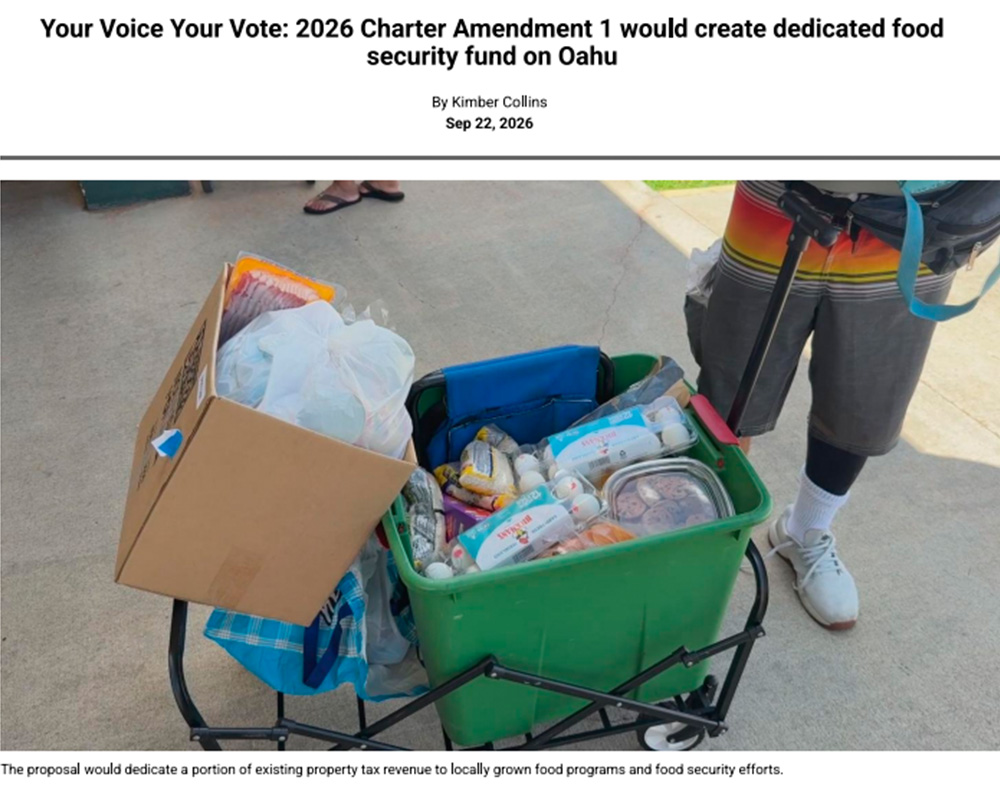
The proposal would dedicate a portion of existing property tax revenue to locally grown food programs and food security efforts.
HONOLULU (Island News) — For people lining up at food distributions across Oahu, the rising cost of groceries is making access to food an increasingly important issue.
Now, food security is the subject of the first of 20 proposed Honolulu charter amendments voters will consider on the Nov. 3 general election ballot.
Question 1 would create a new Food Security Fund and require the city to provide annual funding for it.
Proposed fund to feed Oahu
Honolulu voters will decide whether to create a new Food Security Fund as part of 20 proposed charter amendments on the Nov. 3 general election ballot.
The amendment would increase the total amount of estimated real property tax revenue dedicated to special funds from 2.5% to 3%.
The Honolulu City Charter currently requires funding for five special funds:
- Clean Water and Natural Lands
- Affordable Housing
- Climate Resiliency
- Honolulu Zoo
- Grants in Aid
The proposal would create a sixth special fund dedicated to food security.
It would also increase the total amount of estimated real property tax revenue dedicated to the city’s special funds from 2.5% to 3%.
The six funds would receive an equal share of that money.
The proposal itself does not increase the real property tax rate. Instead, it changes how existing property tax revenue is allocated.
The proposal could generate up to about $8 million a year for food security, according to supporters.
What could the money be used for?
Under the proposed charter language, Food Security Fund money could be used for programs, grants and subsidies designed to:
- Increase access to healthy, affordable food grown, raised or harvested in Hawaii.
- Support the purchase and distribution of locally produced food.
- Strengthen Oahu’s food supply and distribution system.
- Support the use of locally produced food that might otherwise not reach the market.
During a declared emergency, up to 10% of the fund’s total unencumbered balance could be used to purchase food that does not meet the local-food requirement, but only to the extent necessary to address the emergency or disruption.
The charter language also says the new appropriations would be in addition to, rather than a replacement for, historical appropriations for the purposes covered by the special funds.
Why supporters say it’s needed
Hawaii Foodbank President and CEO Amy Miller said about one in three households statewide is food insecure.
“About one in three households in Hawaii is food insecure, meaning there’s not enough food in that household for everybody to live a healthy, active lifestyle,” Miller said.
Miller said that can mean families changing the quality of food they buy, skipping meals or going without food entirely.
She said the Foodbank was involved in developing the proposal.
“We were involved with the commission. We helped actually put forth this proposal,” Miller said.
Miller said the Foodbank sees the proposal as a way to make food security a more permanent part of the city’s budget.
“By creating a fund that puts food insecurity, food security up there with housing and access to clean air, sorry, clean water and lands, climate resiliency, these are the things that are really important to us,” Miller said.
The Foodbank also points to the connection between food security and Hawaii’s agricultural industry.
Miller said:
“The other piece that’s exciting about this particular charter amendment is all of those dollars stay local. So it’s all for local food. It will help improve our local food systems, our local farmers, our local businesses.”
The proposal is backed by a coalition of more than 60 organizations, according to Miller.
The impact of storms and emergencies
Supporters also said recent storms have highlighted the importance of having a reliable local food supply.
Miller said the Foodbank has seen demand increase after a series of weather and other disruptions.
“We had the Kona Lows, and then Lala, and now Lowell. And I will say, the need just continues to increase,” Miller said.
The city and Foodbank have worked together on emergency food response.
Most recently, the city provided $200,000 to help Hawaii Foodbank source and transport food for Oahu distributions following Tropical Cyclone Lala.
The city also recently helped raise more than 170,000 meals for the Foodbank through its annual food drive.
What does the city say?
The City and County of Honolulu’s Department of Budget and Fiscal Services said creating another special fund would place additional restrictions on how the city can use its revenue.
In a statement provided to Island News, the department said:
“Creating another special fund through a carve out of estimated real property tax does further constrain the city’s operating and capital improvement program budgets.”
The department said that could reduce the city’s flexibility to fund core services, including:
- Police
- Fire
- Emergency medical services
- Ocean safety
- Refuse collection and processing
- TheBus, Handi-Van and Skyline
- Maintenance of city buildings
- Streets, sidewalks and bridges
- Stream beds and other infrastructure
The department also emphasized that real property taxes are the city’s primary source of funding.
“It’s very important to expend funds in a fiscally responsible manner considering that the city’s main source of funding comes from the real property tax collections.”
The city said money that remains in existing special funds can also carry over from year to year and help address future budget needs, revenue shortfalls, emergencies and unexpected expenses.
The department said the city currently prioritizes funding its primary functions and that local agricultural and food production programs are not currently considered among those primary functions.
However, the city said the mayor and City Council could potentially fund some local food production and food insecurity programs through the annual Grants in Aid program.
When would the money become available?
The charter amendment establishes the fund, but additional city legislation and rules would be needed to determine how the program operates and how organizations can apply for funding.
The Department of Budget and Fiscal Services gave a rough projection of two to three years after establishment before community organizations could potentially begin accessing the fund.
The department also said a future possibility could be using city matching funds to help secure federal funding for food security programs.
The proposal allows money to be awarded directly to qualified nonprofits, government entities, educational institutions and other eligible recipients under criteria established through city legislation or administrative rules.
What happens if Question 1 passes?
If approved by voters, the Food Security Fund would become part of the Honolulu City Charter.
The city would then have to establish the procedures governing how the money is administered and spent.
Money remaining in the fund at the end of a fiscal year would not lapse. It would remain in the fund and accumulate from year to year.
Administrative expenses would be limited to 5% of the money in the fund.
When will voters decide?
Question 1 is the first of 20 Honolulu charter amendment questions on the Nov. 3, 2026 General Election ballot.
The Honolulu City Council has published the full list of charter amendment questions and final proposals online.